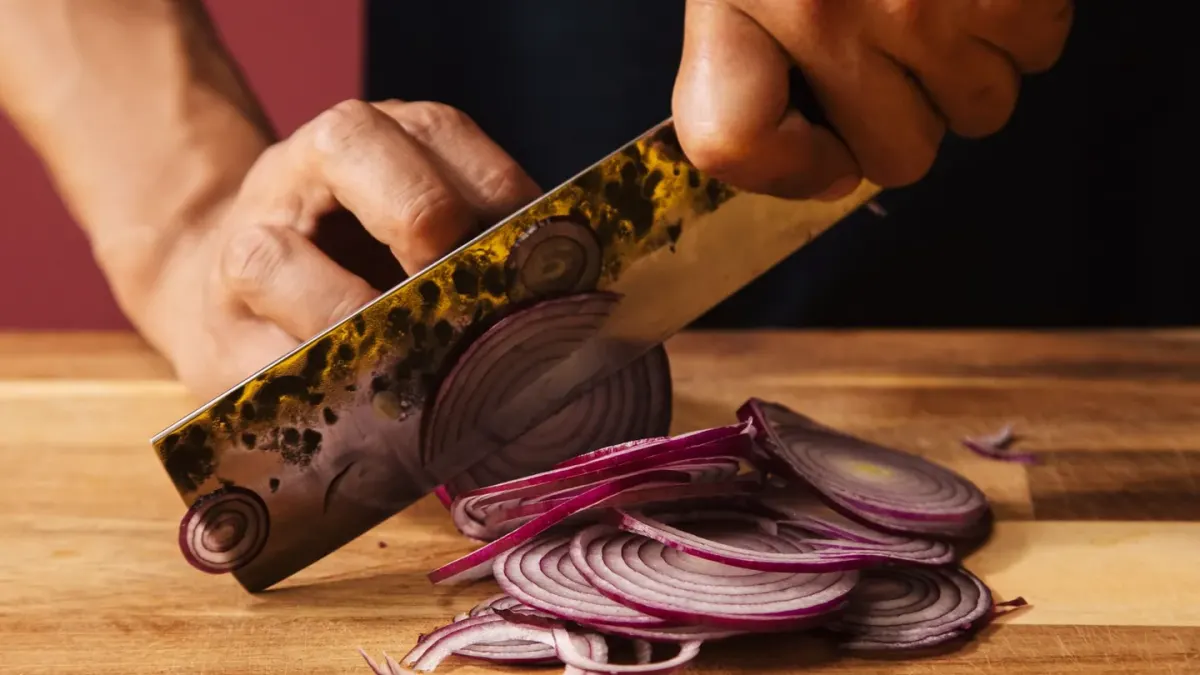
Here’s the decision fork most owners actually face: a bit of sautéed onion falls off the cutting board, the dog under the table snaps it up before you can react, and you’re left standing there wondering whether this is a five-minute worry or a five-day one. I want to answer that plainly before we get into the mechanism, because the plain answer matters more than the biochemistry when you’re the one holding the leash at midnight. Onions are toxic to dogs. Not “in large amounts,” not “if he’s sensitive,” but toxic as a category, in every form they come in.
A dog doesn’t need a bowl of onions to be at risk. A picture I keep coming back to, built from the kind of evening every dog owner has lived through: a beagle mix waits under the kitchen table while dinner gets chopped, catches a fallen sliver of yellow onion, and swallows it before anyone notices. Nothing happens that night. The dog eats his own dinner, sleeps on the couch, seems completely normal the next morning too. Two days later he’s quieter than usual, breathing a little fast after a short walk, gums looking paler than pink. That gap between the bite and the symptom is the whole story of Allium toxicity, and it’s why so many owners miss it entirely — the damage doesn’t announce itself on day one.
Could a Little Onion in Dinner Really Hurt My Dog?
Onions, garlic, leeks, chives, and shallots all belong to the Allium genus, and all of them carry sulfur-containing oxidant compounds that attack a dog’s red blood cells from the inside. According to the Merck Veterinary Manual, “absorption of these oxidant compounds results in oxidative damage to RBCs, Heinz body formation, and methemoglobinemia, which begins within 24 hours and peaks in approximately 72 hours.” Heinz bodies are clumps of damaged hemoglobin inside the cell, and once a red blood cell is marked that way, the spleen starts pulling it out of circulation. Enough of that happening at once is what produces hemolytic anemia.
I think in terms of mechanism before I think in terms of outcome, because that’s what actually tells you how to act. This isn’t a stomach-upset problem you can wait out. It’s a slow, cumulative injury to the cells carrying oxygen through the body, and the clock starts the moment the onion is swallowed, not the moment a symptom shows up.
How Much Onion Does It Actually Take?
Doses matter for understanding risk, less for deciding whether to worry. Per the Merck Veterinary Manual, clinical signs in dogs have been documented at roughly 15 to 30 grams of raw onion per kilogram of body weight, and garlic is considered several times more potent than onion by weight. That’s genuinely useful context if a dog raided a whole rotisserie chicken carcass with onion still clinging to it. It’s much less useful for the everyday case of a stray piece of table food, because dogs vary in how their bodies handle oxidative stress, and nobody is running a lab test in the kitchen before deciding whether to call the vet. I land on the side of treating any real ingestion as worth a phone call, not because every case turns into an emergency, but because the number that would reassure you isn’t reliable enough to lean on.
What Do the Warning Signs Actually Look Like?
Hemolysis “typically occurs 3–5 days after exposure,” per the Merck Veterinary Manual, and clinical signs generally aren’t noticed until substantial red blood cell breakdown has already happened. What owners tend to see, once it does show, includes lethargy, loss of appetite, fast or labored breathing, a racing heart, weakness, pale or yellow-tinged gums, and dark urine. None of that looks dramatic on day one. It looks like a dog who’s a little off, which is exactly why this poisoning gets missed until it’s serious. If you know or strongly suspect a real ingestion happened, don’t wait for the gum color to change before you call.
What About Broths, Baby Food, and “Just a Little Garlic Powder”?
This is where I get more decisive than some sources, and I’ll name the counterargument honestly: plenty of owners assume that trace onion or garlic powder in a broth, gravy, or seasoned baby food (sometimes used as a topper for sick or picky dogs) is too diluted to matter, and for a single lick it very often is. But powdered Allium is concentrated exactly because the water’s been removed, and it hides easily in exactly the foods owners reach for when a dog is already not eating well — which is the worst possible moment to introduce an oxidant load onto a body that may already be under stress. I don’t think the convenience of a seasoned broth is worth that trade. If you’re looking for something to perk up appetite or ease a transition, Can Dogs Eat Sweet Potato? covers a genuinely dog-safe topper, and if the issue is a food switch itself rather than flavor, How to Change Food for a Senior Dog walks through a gentler way to do that without leaning on kitchen scraps.
It’s also worth separating this from ordinary dietary upset. A dog with loose stool after a food change usually isn’t dealing with oxidative red cell damage, and if fiber load looks like the culprit instead, Can You Give a Dog Too Much Fiber? is the more relevant read. Onion toxicity is a different animal entirely, and it’s the one I’d rather you rule out first if the timeline and the ingredient list line up.
The Bottom Line
I’d rather be plain than clever here: keep onion, garlic, leeks, chives, and shallots away from your dog’s bowl, table scraps, and countertop reach, in every form they come in. The dose thresholds are real, but they’re not something I’d bet a dog’s red blood cells on. If a real ingestion happens, call your veterinarian and describe the amount and the timing as best you can — that gap between exposure and symptom is exactly the window where a phone call does the most good.
Frequently asked questions
How much onion is actually dangerous for a dog?
Documented toxicosis in dogs has occurred at roughly 15 to 30 grams of raw onion per kilogram of body weight, according to the Merck Veterinary Manual. In practical terms, that's a fairly small fraction of a dog's own weight, and it doesn't account for how individual dogs handle oxidative stress differently. I don't treat that number as a safety line, only as evidence that this is a real, measurable toxicity and not folklore.
Is cooked onion safer than raw onion for dogs?
No. Cooking, drying, and powdering onion do not neutralize the oxidant compounds responsible for red blood cell damage. Powdered onion and garlic are, if anything, easier to ingest in a concentrated dose because they hide inside broths, gravies, and seasoning blends.
My dog ate a small piece of onion and seems fine. Do I still need to call the vet?
I'd still make the call. Red blood cell damage from Allium ingestion can begin within 24 hours and clinical signs of anemia may not show up for several days, so 'seems fine right now' isn't the same as 'is fine.' A vet can help you weigh the amount eaten against your dog's size and decide whether monitoring or bloodwork makes sense.
Are garlic, leeks, and chives just as risky as onions?
Yes — they're all in the Allium family and share the same basic mechanism. Garlic is generally considered several times more potent than onion gram for gram, so a small amount of garlic carries more risk than the same weight in onion.
Sources
- Garlic and Onion (Allium spp) Toxicosis in Animals — Merck Veterinary Manual