On this page
It’s almost always the same call. Someone’s holding the phone in one hand and a sleeve full of puncture marks in the other, and the question underneath the question is: is my puppy going to be like this forever?
I’ve sat with that worry more times than I can count. A few years ago I worked with a family who’d brought home an 11-week-old Australian Shepherd, a bright, busy little dog who turned into a piranha every evening around 6pm. The kids were in tears, the dad wanted to call it quits on the breed, and the mom kept saying “he was so calm at the breeder’s.” What was actually happening was ordinary and fixable: an overtired, understimulated puppy hitting his worst arousal window of the day, using the only tool he had — his mouth — to ask for the game to stop or the nap to start. We didn’t punish the biting. We rebuilt the evening routine around a chew session and an earlier crate nap, and within about three weeks the witching-hour piranha act had mostly faded.
Why your puppy is doing this in the first place
Puppies bite because that’s how they investigate texture, practice hunting motions, and — critically — learn how hard is too hard. In the litter, a puppy who bites a littermate too hard gets a yelp and the game stops. That’s bite inhibition forming in real time, and it’s the single most important skill your puppy can leave puppyhood with, more important than “no biting at all.” A dog who never learned to modulate pressure is a much bigger liability as an adult than one who mouths gently.
Teething adds fuel to this. Baby teeth start falling out around 12 weeks, and the gums stay uncomfortable on and off until the adult set is in, usually by 6 months. A lot of the sharpest nipping clusters around that window, not because training has failed, but because the puppy’s mouth genuinely hurts.
The early weeks: teach the mouth to soften, not to disappear
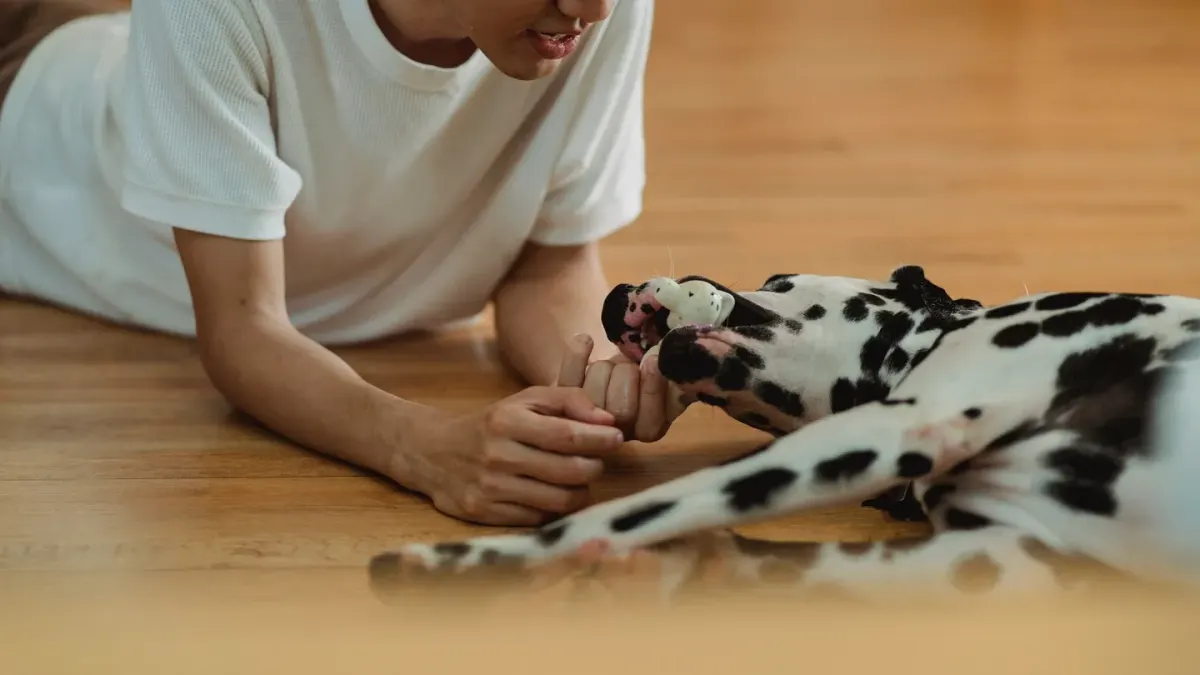
In the 8-to-12-week stretch, my advice to owners is almost never “stop the biting.” It’s “make the biting softer.” When your puppy’s teeth land too hard during play, let out a sharp, single “ow,” stop moving your hand, and pause the game for a few seconds. Don’t yank away — a fast-moving hand is exactly what a puppy’s brain is wired to chase. If he goes back to a gentler mouth, resume play as the reward. If he escalates, end the session and walk away for a minute. You’re not trying to eliminate mouthing yet; you’re teaching pressure control, one repetition at a time.
Weeks 12–20: redirect before the teeth land
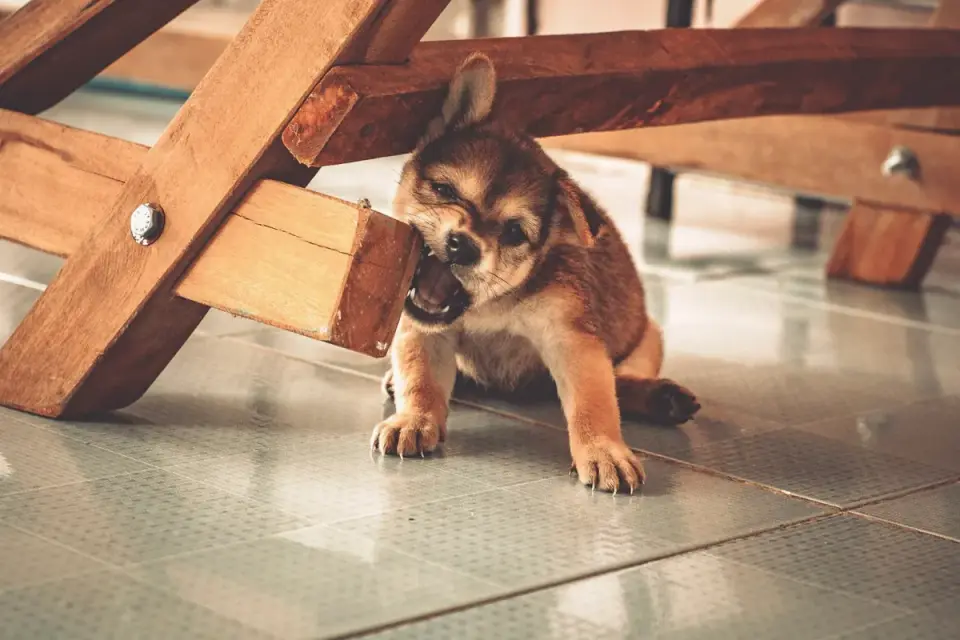
Once a puppy has some bite awareness, shift the job from “react to nips” to “get ahead of them.” Watch for the tell — the stiffening body, the fixed stare at your hand, the little pre-pounce crouch — and put a toy in the gap before teeth make contact. A frozen washcloth or a firm rubber chew can take real pressure off sore teething gums. Keep several chew toys staged around the house rather than in one bin, so there’s always something within reach the second your puppy starts hunting for a target.
This is also the age where I ask families to look honestly at exercise and sleep, not just training technique. A puppy who’s had one short leash walk and no mental work by dinnertime is going to bite more, not because he’s poorly trained but because he’s overstimulated and doesn’t yet have the self-control to settle himself. Puppies this age typically need far more sleep than owners expect, and an overtired puppy mouths harder, not softer.
When overarousal, not defiance, is driving the biting
By far the most common pattern I see isn’t a puppy testing dominance — it’s a nervous system that’s revved up and has no off switch yet. This shows up as biting that spikes at the end of the day, during guests arriving, or right before a crash-nap. Management matters most here: a predictable wind-down routine, a quiet space to decompress, and enough physical and mental output earlier in the day so the evening isn’t the first chance the puppy’s had to burn energy.
Some owners ask about calming aids for a puppy who runs hot in the evenings. A few ingredients have real support behind them for general stress and anxiety, though the evidence in dogs specifically is still thinner than in people. A systematic review in Cureus found that KSM-66 ashwagandha has a moderate positive impact on stress reduction and cognitive performance across the RCTs it analyzed. L-theanine, an amino acid found in tea, has been studied for its calming properties, though a review in Molecular Psychiatry found benefit mainly in one study on psychotic anxiety at 400 mg/day for 8 weeks — a human dose, not a canine one. Chamomile has a longer history here too: a review in Biomedicines notes that for most species, the evidence is still mainly preclinical or drawn from traditional use, and chamomile and valerian root have long been used in traditional herbal care to support relaxation. None of this replaces the training and sleep piece — it’s a supporting player, not the fix — and I’d rather see a family nail the routine first. If you want the fuller rundown on what’s actually worth trying, our calming supplement guide breaks down the options by evidence level.
What to actually stop doing
Skip the alpha-roll, the muzzle hold, the yelling. These don’t teach bite inhibition — they teach a puppy that hands are unpredictable and sometimes scary, which can produce a dog who bites with less warning later, not more. If your puppy is biting out of fear or discomfort rather than play, the mouth signal deserves the same respect as a growl does — it’s information, not defiance. We’ve written separately about what it means when a dog growls during petting, and a lot of the same logic applies here: read the signal, don’t punish it away.
When it’s more than a phase
Most puppies soften considerably by 6 months as bite inhibition sets in and adult teeth finish coming in. If your puppy is still biting hard enough to break skin regularly past that point, if the biting is paired with stiff body language, guarding, or genuine fear rather than play, or if nothing you’re doing seems to be shifting the pattern at all, it’s worth a session with your veterinarian or a certified trainer. That’s not a failure on your part — some puppies need a more individualized plan, and it’s much easier to redirect the pattern early than to unwind it at 18 months.
I think about that Australian Shepherd family often, mostly because nothing dramatic fixed it. No product, no single training trick — just an earlier nap, a chew session before dinner, and three weeks of consistent, boring repetition. That’s usually how this goes. The puppies who “just grew out of it” almost always had an owner quietly doing the unglamorous work in the background the whole time.
The short version
Teach a soft mouth before you expect no mouth at all. Redirect early, manage sleep and stimulation like they’re part of the training plan, and skip the punishment-based tactics that just make a puppy’s mouth less predictable. Give it real time — most of the hardest biting is gone by 6 months in dogs who get consistent, calm feedback along the way.
Frequently asked questions
At what age do puppies stop biting?
Most puppies significantly reduce hard biting by around 6 months, once adult teeth are in and bite inhibition has developed through consistent, calm feedback during play.
Should I yelp when my puppy bites too hard?
A sharp, single "ow" followed by a brief pause in play can help, but if your puppy gets more excited by the sound, switch to silently stopping the game and redirecting to a toy instead.
Is it normal for puppy biting to get worse before it gets better?
Yes, especially during the 12-to-20-week teething window, when sore gums and rising energy levels can make nipping spike temporarily even with consistent training.
Sources
- Ashwagandha and Stress: A Systematic Review — Cureus
- L-Theanine and Anxiety: A Review — Molecular Psychiatry
- Chamomile in Anxiety and Stress Across Species — Biomedicines