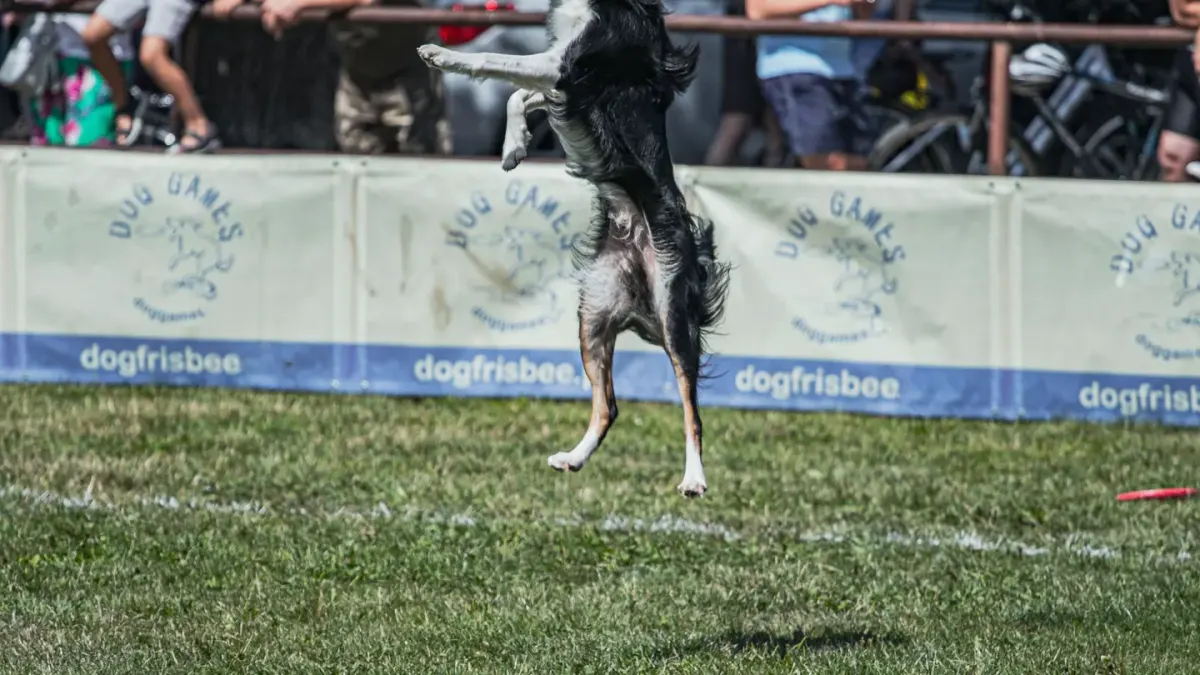
The fork hits fast at the park: your big dog flattens a tennis ball in ten minutes, so you start hunting for an indestructible dog ball built for a large dog — or you start wondering if tougher is even the right goal.
From a nutrition and sports-medicine view, I weigh what that ball can realistically do for diet, mobility, and recovery, and a ball does none of those jobs if it becomes a choking risk or a slab fracture. My position is steady: pick size first, then give, then toughness, in that order.
If it fits behind the canines, it does not go in the mouth
For large dogs, the swallow risk comes before everything. A ball should be clearly too large to be trapped behind the canine teeth or slipped whole into the back of the mouth, with room to spare when the dog compresses it during fetch.
Owners often judge by the dog’s enthusiasm, not the airway. Vets often see the opposite problem in practice — a dog that has carried the same medium ball for months without trouble, until one hard run, one deep pant, and one wrong bounce turns it into an emergency.
Give matters next. Very hard nylon, dense rubber, and compressed felt can wear enamel and raise the risk of a fractured upper premolar, especially in middle-aged and older large dogs whose teeth have already done years of work. The American Veterinary Medical Association notes that dental injury and periodontal disease are common and painful in dogs, which is why daily chewing hardness deserves the same attention as food texture.
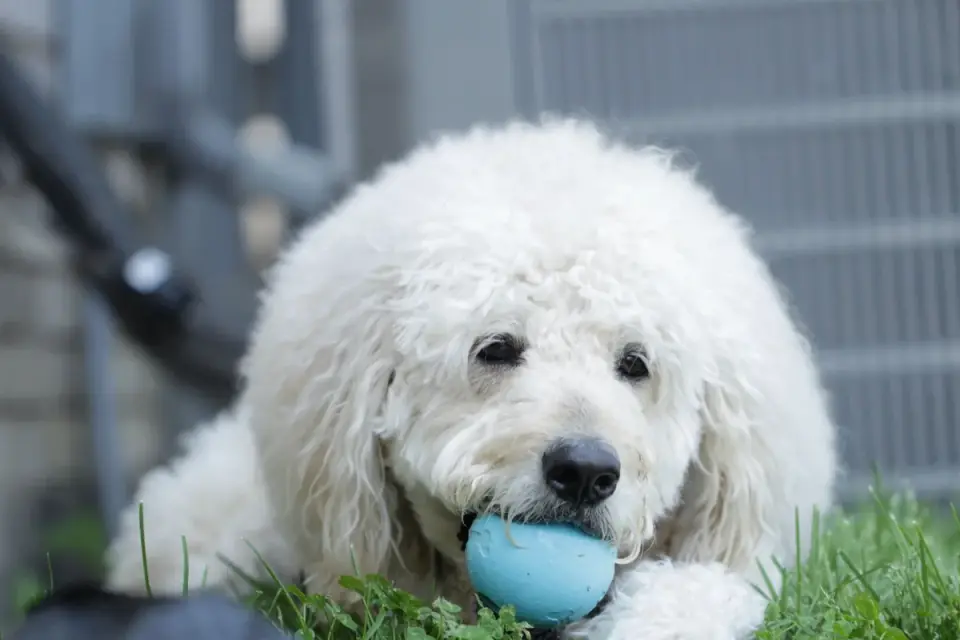
A useful at-home check is the thumbnail test: if you cannot make a slight dent in the ball surface with your thumbnail, assume your dog’s tooth cannot either without taking the load itself.
Choose give first, toughness second
I prefer a large, slightly deformable solid rubber or thick-walled hollow ball over a rock-hard “chew-proof” sphere. Food therapy and rehab teach the same lesson — tissues adapt to repeated moderate load, but they break under single-point overload.
Look for one continuous molded piece, no glued seams, no squeaker slit, no peeling outer fuzz. Fuzz and flaking covers add grit to teeth and invite chewing the cover off. A smooth, washable surface also lets you rinse off sand and grit that acts like sandpaper on enamel.
Size it generously. For most dogs over 50 pounds that means moving up to a 3- to 3.5-inch ball rather than a standard 2.5-inch tennis ball, and larger still for giant breeds. If you are unsure between two sizes, take the larger one for fetch.
The American Animal Hospital Association dental guidelines remind us that fractured teeth often need professional care under anesthesia, so prevention by avoiding excessively hard chew objects is kinder than repair.
That prevention mindset also shapes evening routines.
A ball that is perfect for daytime fetch can still be wrong for late-night settling. For low-noise indoor time, many apartment owners do better with soft sniffing and licking work from Enrichment Toys for Mental Stimulation: What Actually Helps a Bored Dog rather than another round of bouncing fetch, and the ideas in Best Toys for Apartment Dogs with Limited Space translate well to keeping a large dog quiet without a hallway marathon.
When to retire the ball you already own
No ball stays safe forever.
Retire it when you see flat spots that change the bounce, cracks that open under squeeze, missing chunks, a sticky surface that holds grit, or a size that once looked big and now looks borderline. Large dogs compress toys with surprising force, and a ball that fit last year may be small for a now fully grown adolescent.
Cleaning helps you inspect. Rinse solid balls with warm water and mild soap, air-dry fully, and check the seam and vent hole each time. If you rotate plush or fabric toys too, the fork-in-the-road in Can You Wash Dog Toys in the Washing Machine? A Vet’s Honest Fork-in-the-Road is a useful guide for what can go in the machine and what should stay out.
Save the long throws for open space. For technique, distance, and launcher safety, Best Fetch Toys for Dogs: How to Choose Balls, Bumpers, and Launchers walks through how ball shape changes bounce and mouth feel.
Toughness still has a place. It just sits third in line.
My recommendation stays evidence-bounded: a too-big-to-swallow, thumbnail-give ball that you replace early may help support healthy teeth and calm, repeatable exercise. The best reason to choose differently is a true power chewer who dissects anything soft — then choose supervised fetch only, put the ball away between throws, and give chewing needs a separate, appropriately sized outlet.
Frequently asked questions
What size ball is safe for a large dog?
Choose a ball that cannot fit fully behind the canine teeth, usually 3 inches or larger for dogs over 50 pounds. When between sizes, pick the larger ball for fetch and replace it if it shows compression or cracking.
Are hard indestructible balls bad for teeth?
Very hard balls can increase wear and fracture risk, especially in older dogs. Look for a ball with slight give under thumbnail pressure, a smooth one-piece surface, and no peeling cover.
Sources
- Pet dental care — American Veterinary Medical Association