
On this page
What’s actually different about an apartment dog
Here’s the fork most owners hit around week two in a new apartment: your dog is bored, you can feel it, and the instinct is to buy something bigger — a bigger ball, a bigger rope, something that’ll really wear them out. But in a apartment, “bigger” usually means louder, bouncier, or more likely to end with a neighbor knocking. The better question isn’t how big a toy is. It’s whether it burns mental energy without burning through your floor space or your upstairs neighbor’s patience.
I’ve spent a lot of clinic hours with owners who moved from a house with a yard into a one-bedroom and watched their dog’s whole behavior shift within a month — more pacing, more whining at the door, more of that low-grade restlessness that’s hard to name but easy to feel. One case that’s stuck with me: a 34-pound mixed-breed named Otto, four years old, whose owner worked from a desk twelve feet from his crate. Otto had been a yard dog. In the apartment, he started shredding cardboard, digging at the same corner of the rug every afternoon around 2 p.m., and the neighbor below had already left one polite note. What changed things wasn’t a bigger toy — it was swapping his free-fed bowl for a slow-feed puzzle and adding a frozen stuffed toy before the owner’s afternoon calls. Within about three weeks, the 2 p.m. digging had mostly stopped, and the cardboard stayed intact.
That’s the pattern I want to walk through: what kind of toy actually meets an apartment dog’s needs, and why chasing size or noise usually misses the point.
Why mental work beats physical noise in a small space
Physical exercise matters, but square footage puts a hard ceiling on how much fetch or tug you can realistically offer indoors. Mental work doesn’t have that ceiling. Food puzzle toys ask a dog to problem-solve for a reward, and that kind of foraging behavior is close to what dogs are built to do — work for food, not have it appear in a bowl. A pilot study published in Applied Animal Behaviour Science and documented on ScienceDirect found that feeding enrichment toys increased appetitive feeding behavior and reduced inactivity and abnormal repetitive behaviors in kennelled dogs, which is a useful data point even though it wasn’t run in a home apartment setting — the underlying mechanism (work for food, not free food) still applies. The American Veterinary Society of Animal Behavior recommends food puzzle toys as a standard enrichment tool and notes they can help address problem behaviors tied to boredom or excess energy, which is exactly the profile of a lot of apartment dogs I see.
Practically, that means a slow-feed puzzle, a snuffle mat, or a stuffable rubber toy will usually do more for a restless apartment dog than a squeaky ball that bounces off the wall every ten seconds. The engagement is quieter, it’s contained to one spot on the floor, and it takes longer — which is the whole point when you’ve only got 600 square feet to work with.
The noise problem nobody puts on the toy packaging
Barking triggered by boredom or separation anxiety is one of the most common reasons apartment dwellers get a noise complaint in the first place, according to the ASPCA, which lists vocalization as a hallmark separation-anxiety symptom that often starts within the first thirty minutes alone. A toy that’s meant to occupy your dog while you’re out — a stuffed Kong-style toy, a long-lasting chew, a puzzle feeder loaded before you leave — is doing double duty: it’s mental enrichment, and it’s a noise-prevention tool, because a dog absorbed in extracting peanut butter from a rubber toy isn’t barking at the hallway.
Squeaky toys deserve a specific caution here, not because they’re bad toys, but because they’re the wrong fit for thin walls. A toy that squeaks every time your dog mouths it, especially one left out for solo play, can turn into a repetitive noise source at exactly the hours — early morning, late evening — when neighbors notice most. Save the squeaky toy for supervised play and reach for something quiet for solo hours.
What actually holds up in a small footprint
A few categories consistently do the job well for apartment living:
- Slow-feed puzzles and snuffle mats — turn a meal into ten or fifteen minutes of quiet, contained foraging instead of ninety seconds at the bowl.
- Stuffable rubber toys (frozen with wet food or a spoonful of plain pumpkin) — long-lasting, low-noise, and genuinely absorbing during the first stretch of alone time, when anxiety-driven barking is most likely.
- Flat, low-bounce chew toys — satisfy a chewer’s drive without the ricochet-off-the-wall problem a bouncy ball creates in a small room.
- Short-session tug or fetch toys used only during active playtime — fine in an apartment when they’re supervised and put away afterward, rather than left out as a default solo toy.
One short note worth sitting with on its own: rotate the toys weekly rather than leaving all of them out at once — novelty does a surprising amount of the enrichment work.
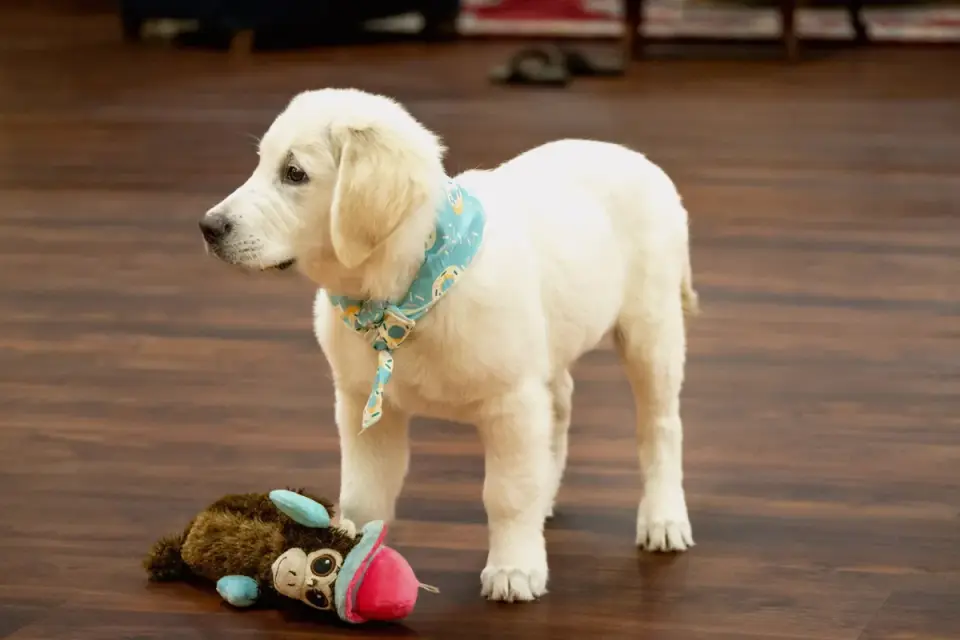
If your dog is still teething, the calculus shifts again — a puppy’s sore gums call for softer textures than an adult’s would, which is worth reading up on separately in our guide to teething toys that soothe a puppy’s sore gums, and knowing roughly when puppies stop teething and need different toys so you’re not stuck rebuying the wrong hardness every few months.
Where I land, and the honest counterargument
The strongest pushback I hear from owners is fair: “My dog needs to run, not just sniff a mat.” That’s true, and no toy replaces a walk. A tired body still matters, and I’m not telling anyone to skip the leash. But when I weigh what a toy can realistically do for an apartment dog’s day against what it can’t, the toy’s job isn’t cardio — it’s occupying the mind during the hours a walk can’t cover, and doing it quietly enough that it doesn’t create a second problem. I’ve watched owners double down on high-energy fetch toys indoors, hoping to substitute for outdoor space, and mostly what that buys them is a knocked-over lamp and a dog that’s wound up rather than settled. The quieter, slower option isn’t a downgrade. For a small floor plan, it’s the better tool for the specific job.
If your dog’s restlessness looks more like true separation anxiety — pacing, drooling, destruction concentrated near doors and windows — toys are a helpful piece of the puzzle, not the whole plan, and it’s worth talking to your veterinarian about a fuller behavior plan alongside them.
A related space-planning question worth a second look: whether the breed itself, not just the toy box, is doing you any favors. We’ve written about that directly in the real test for an apartment dog, and if allergies are part of your household’s calculus, our guide to hypoallergenic dog breeds covers that separately.
So — what’s actually keeping your dog up at 2 p.m., the boredom or the bark it turns into?
Frequently asked questions
Are squeaky toys bad for apartment dogs?
Not inherently, but they're a poor fit for solo, unsupervised play in a thin-walled apartment. Save squeaky toys for supervised sessions and use quieter puzzle or chew toys when your dog is alone.
How many toys should an apartment dog have out at once?
Fewer than you'd think. Rotating two or three toys weekly keeps novelty high, which does more for engagement than leaving a full toy box out all the time.
Can a puzzle toy actually reduce barking?
It can help with boredom-driven barking by giving your dog something absorbing to do during alone time, though true separation anxiety usually needs a broader behavior plan alongside any toy.
Sources
- A Guide to Using Food Puzzle Toys with Your Dog — American Veterinary Society of Animal Behavior
- Separation Anxiety — ASPCA
- The effect of feeding enrichment toys on the behaviour of kennelled dogs (Canis familiaris) — ScienceDirect