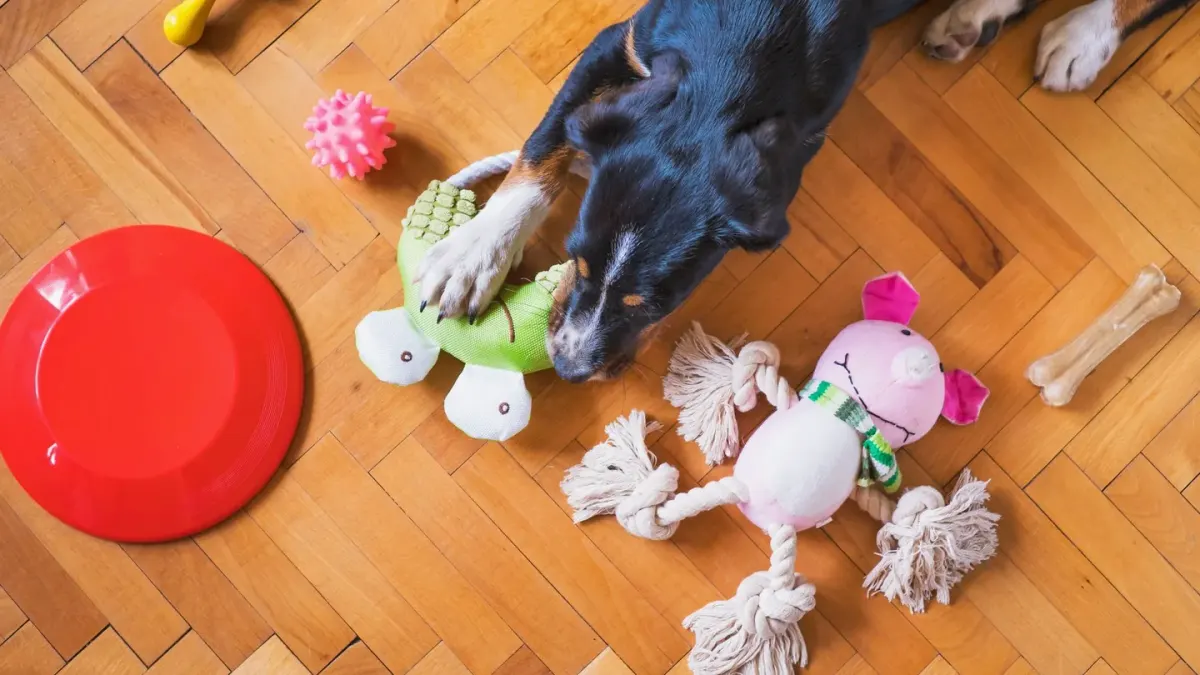
Somewhere between the fourth and sixth month, owners start finding a tooth on the kitchen floor — small, oddly sharp, easy to mistake for a piece of kibble until you look twice. It’s a normal milestone, not an emergency, and it’s also the moment I get asked the same question in almost every exam room: is she still teething, or is this just how she chews now?
The honest answer is that it’s usually both, for a while.
The mouth changes in stages, not all at once
A puppy’s 28 baby teeth — technically deciduous teeth — are typically all in by six to eight weeks, and they start loosening around three and a half to five months as the permanent set pushes up underneath. Incisors and canines tend to go first, premolars in the middle stretch, molars last. According to PetMD, the full 42-tooth adult set is usually finished coming in by five to seven months, and the American Kennel Club puts most puppies at having the majority of their adult teeth by six months, with the last molars occasionally trailing into month seven or eight. Large-breed puppies tend to finish slightly earlier than small ones — their jaws simply have more room to work with.
What that means functionally is that the mouth doing the chewing at four months is not the mouth doing the chewing at eight months. The gums are inflamed and tender during eruption; puppies chew compulsively then because pressure on a swollen gumline is genuinely relieving, the way pressing on a sore muscle can feel better than leaving it alone. By the time the adult teeth are seated, the drive to chew doesn’t disappear — it just stops being about pain and starts being about jaw strength, boredom, and a still-developing bite force that keeps climbing well past a year of age in most breeds.
Why the same toy stops working
I’ve watched this play out with a lot of young retrievers and shepherds in particular, because their bite strength develops fast. One Labrador I worked with, about five months old and already pushing fifty pounds, had gone through two “indestructible” rubber chews in as many weeks — not because the toys were poorly made, but because a five-month-old jaw is a completely different tool than the one that first chewed on them at ten weeks. The owner had been buying softer, flexible teething rings meant to flex against sore gums, and by month five that flex was exactly the weakness her dog was exploiting; she’d get a corner between her molars and simply peel it. Swapping to a firmer, single-piece rubber design solved it within days, not because the dog “graduated” in some abstract sense but because the physical match between jaw and material had shifted.
That’s the real signal to watch for, more than a date on a calendar: does the toy still survive normal use, or is your dog systematically finding its weak points? A toy shredded in an afternoon isn’t a toy failure at ten weeks — it’s expected. The same result at seven months usually means the toy is undersized for the bite now doing the work.
Soft, flexible, and textured toys earn their keep during the eruption window — roughly three to seven months — because they’re gentle on inflamed gums and the give in the material actually feels good against pressure. Freezing a wet washcloth or a rubber teething toy adds a numbing effect that a lot of puppies clearly prefer during the worst weeks. Once the adult teeth are in and stable, usually by six to eight months, the priority flips: durability, size-appropriate density, and shapes that resist a stronger, more deliberate bite matter more than softness. A toy that was perfect for a sore-gummed ten-week-old can become a choking risk once it’s chewed thin by a stronger adult jaw, so this isn’t just about waste — worn rubber and frayed rope both shed pieces a bigger mouth can swallow.
Some of the chewing habits that start in the teething months don’t fully resolve with age, either. Retained baby teeth — where an adult tooth erupts but the baby tooth doesn’t fall out on schedule — happen often enough that it’s worth a look at any six-month wellness visit, since a retained tooth can crowd the adult one and affect the bite long-term. If you notice what looks like a double row of teeth after six months, that’s a vet visit, not a toy problem.
What I actually tell owners
By the time a dog is chewing through daily meals without discomfort, sleeping through the night instead of gnawing at 2 a.m., and no longer leaving a trail of loose teeth around the house, the teething phase itself is functionally over — usually somewhere in that six-to-seven-month window, occasionally stretching to eight in a slow-to-finish molar or two. What doesn’t end is the chewing drive itself, and that’s the part owners are usually less prepared for. I tend to frame it for clients the way I’d frame any nutrition or joint-support decision: weigh what the object in front of the dog can realistically do for the stage of development it’s actually in, not the stage it was in eight weeks ago. A supplement chosen for a growing joint doesn’t stay right forever either — the same logic that governs when to reassess a glucosamine dose as a puppy grows into an adult applies just as directly to something as ordinary as a chew toy.
If your household is also managing the digestive side of a growing puppy, it’s worth reading how new foods can unsettle a young dog’s gut in our guide on dog stomach upset after switching to raw food. Puppies going through a diet change alongside teething sometimes need a gentler hand with fiber too — see can you give a dog too much fiber for what that actually looks like. And if joint support ever comes up for an older, larger-breed dog down the line, our look at whether hyaluronic acid actually works for dog joints walks through what the research supports.
In short: teething itself is largely finished by six to seven months, but the toy basket should change in step with the jaw, not with the calendar. Watch what the toy looks like after a week of normal use — that tells you more than any age chart will.
Frequently asked questions
At what age do puppies stop teething?
Most puppies finish teething by six to seven months old, with all 42 adult teeth in place; some large-breed dogs finish a bit earlier, and a few puppies have a lingering molar or two into month eight.
How do I know if my puppy still has a baby tooth that hasn't fallen out?
Look for what appears to be two teeth in the same spot, often a canine — a retained baby tooth sitting next to the adult tooth that erupted beside it. That's worth mentioning at your next vet visit rather than waiting it out.
Should I switch toys the moment teething ends?
Not on a fixed date — watch the toy instead. If it's surviving normal chewing intact, it's still doing its job; if your dog is consistently finding weak points and tearing off pieces, it's time for something denser and more size-appropriate.
Sources
- Puppy Teething: Timeline, Signs, and Care Tips — PetMD
- Puppy Teething Timeline — How Long Does Puppy Teething Last? — American Kennel Club