On this page
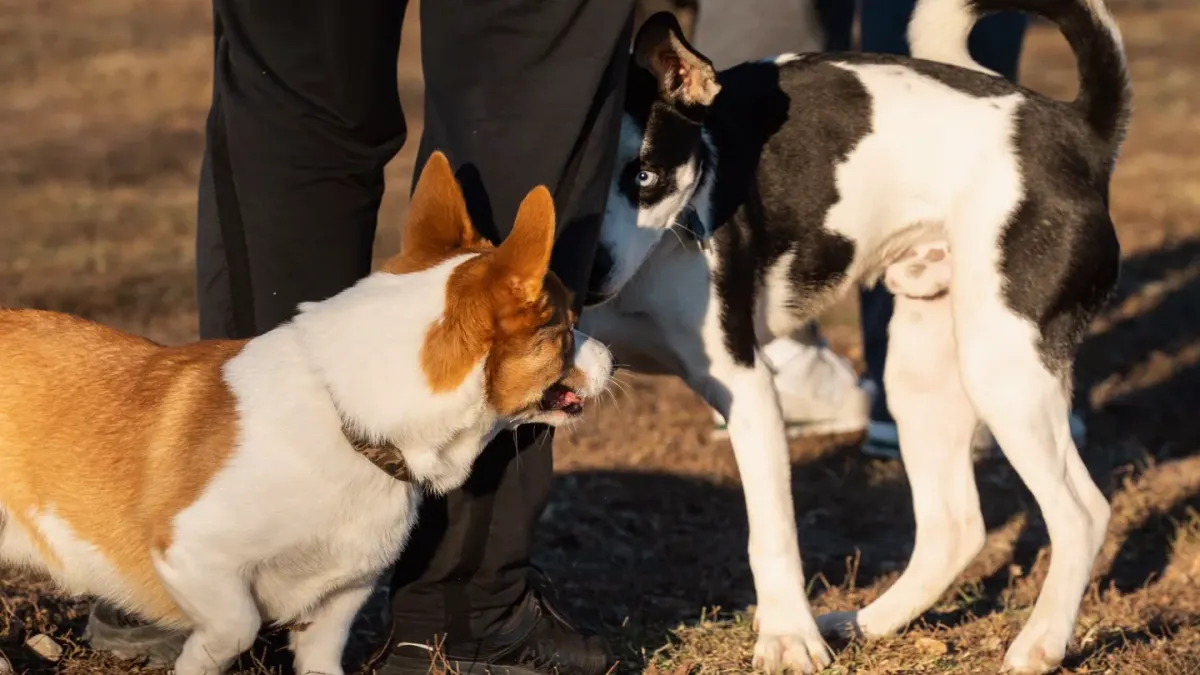
Two dogs are wrestling in your living room, and one of them just let out a sound that made your stomach drop. Do you pull them apart, or do you wait ten more seconds and watch?
That’s the fork almost every owner lands on eventually, and it’s the one I get asked about more than nearly anything else in my exam room. The honest answer is that the noise is the least useful piece of information you have. What separates play from a fight isn’t the noise level — it’s whether both dogs keep offering the interaction back.
The dog who won’t stay down
I once treated a seven-month-old Lab mix named Duncan, about 42 pounds, whose owner brought him in convinced he’d “started a fight” with the neighbor’s older Cattle Dog during their Sunday park meetup. She described growling, bared teeth, and Duncan pinned flat on his back. What she hadn’t clocked — because it happened fast, in the grass, late afternoon — was that Duncan popped back up seconds later and body-slammed the Cattle Dog right back into the same position. That’s role reversal, and it almost never shows up in an actual fight. A dog defending himself doesn’t hand his opponent the advantage a moment later and ask for more. I told her what I tell most owners in that spot: the growling was real, but the game was too.
The signals that actually mean “we’re still playing”
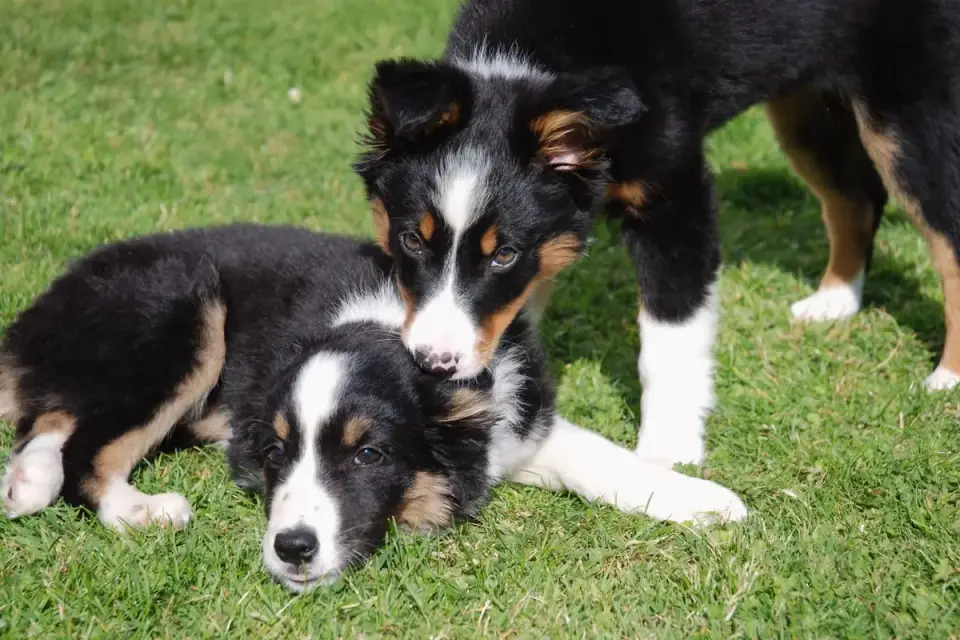
Watch for a loose, bouncy body rather than a stiff, square one. A relaxed, open mouth — sometimes called a “play face” — reads very differently than a mouth clamped shut with the lips pulled back tight. And watch what happens after any big, noisy moment: do the dogs pause, shake off, sniff the ground, then dive right back in? Natural lulls like that are a good sign, not a bad one. Genuine fights don’t have lulls; they end when one dog disengages for good or a person separates them.
Two behaviors matter more than almost anything else:
- Self-handicapping — a bigger or stronger dog voluntarily flops onto his back, slows down, or lets the smaller dog “win” a chase. According to Dog Play-Bows: Understanding Canine Play Signals, the play bow itself functions as an invitation and a reset signal, and much of what follows it — the mock falls, the exaggerated pounces — only makes sense as a voluntary handicap between dogs who trust each other.
- Role reversal — the chaser becomes the chased, the pinner becomes the pinned, over and over, with neither dog holding the advantage for long.
If you’re seeing both of those, you’re very likely watching play, even when it sounds rough. If you’re not — if one dog is always on top, always driving forward, and the other is trying repeatedly to leave and can’t — that’s the moment to intervene, not narrate.
When it’s actually heading somewhere bad
A few signs do tell a different story. A stiff, frozen body with a hard stare. Lips curled straight up with no loose wiggle anywhere else. One dog cornered against a fence or under furniture, still trying to escape after multiple attempts. Real fights also tend to be fast and largely silent compared to how loud they sound in memory — the noise owners recall as “vicious” is often the play growling that accompanies perfectly normal wrestling. Is Your Dog’s Rough Play Appropriate? notes that mismatched size or experience is where things go sideways most often, which lines up with what I see clinically: it’s rarely two evenly matched dogs that end up in my exam room after a real altercation. It’s a young, overexcited dog who hasn’t learned to read a stop signal, paired with an older or smaller dog who’s already tried to leave twice.
If your own dog tends to growl even during calm, affectionate moments — not just rowdy play — that’s worth understanding on its own terms; we cover what that kind of growl usually means in Why Does My Dog Growl When I Pet Him?
A rattled dog after a real scare
Here’s the part owners don’t always expect: even a dog who wasn’t hurt can come home from a scary interaction genuinely rattled — pacing, panting, refusing food he’d normally inhale. I had a client with a nine-year-old Shih Tzu, barely 11 pounds, who’d been on the losing end of a scuffle at a dog park. Physically he was fine within the hour. Behaviorally, he wouldn’t settle that whole evening, and he flinched at the sound of the back door for almost a week. That’s a nervous system that needs time, not correction.
For dogs who stay wound up after something like that, structure/function ingredients can be worth a conversation with your vet, alongside — never instead of — giving the dog quiet, predictable time to decompress. A systematic review in Cureus found that ashwagandha has a moderate positive impact on stress reduction, and a review in Biomedicines notes that for chamomile specifically, evidence in most species is still mainly preclinical or based on traditional use — worth knowing before you expect too much from it. L-theanine has its own research thread; a review in Molecular Psychiatry found a calming effect at 400 mg/day over eight weeks in a human anxiety study, which is a useful data point but not the same as a canine dose. If you’re weighing options, our calming supplement roundup breaks down what’s actually backed by research versus what’s mostly marketing.
What I’d actually tell you to do
Don’t referee based on volume. Growling, barking, even the occasional yelp can all happen in totally normal play, especially between dogs who know each other. Watch instead for the pattern: does the interaction keep resetting, do both dogs keep choosing to come back, is there give as well as take? If yes, let it run and stay nearby. If one dog is repeatedly trying to leave and can’t, or the body language has gone stiff and silent, separate them calmly — no yelling, no grabbing collars from behind — and give both dogs a minute to settle before deciding whether to try again.
Most of the time, what looks alarming from the couch or across the park is actually two dogs speaking a language that’s older than either of them, and doing it well.
Frequently asked questions
Is growling always a bad sign during play?
No. Growling is a normal part of rough-and-tumble play for many dogs. It only becomes concerning alongside a stiff body, a fixed stare, and a lack of role reversal or self-handicapping.
What's the fastest way to tell play from a fight?
Watch for pauses and role reversal. Dogs in genuine play interrupt themselves, shake off, and swap who's chasing whom. A real fight doesn't reset like that.
Should I ever step in during rough play?
Yes, if one dog keeps trying to leave and can't, or if the body language turns stiff and silent rather than loose and bouncy. Separate calmly rather than grabbing collars from behind.
Sources
- Dog Play-Bows: Understanding Canine Play Signals — Kinship
- Is Your Dog's Rough Play Appropriate? — Kinship
- Ashwagandha systematic review on stress and cognitive performance — Cureus
- Chamomile evidence review across species — Biomedicines
- L-theanine and anxiety review — Molecular Psychiatry