On this page
Here’s the decision fork I actually want you to sit with: is your dog gulping because the bowl disappears in nine seconds and that’s just who he is, or is this a dog built like a barrel — deep chest, narrow waist, a Great Dane or a Weimaraner or a Doberman — where speed-eating stops being a personality quirk and starts being a real variable I track. Those are two different conversations, and conflating them is how owners either panic over a Lab who’s always eaten like this, or shrug off a risk that’s worth twenty minutes of their evening.
I want to be honest about where the science actually sits, because this is a topic where confident-sounding claims outrun the data more than almost any other in canine nutrition. Bloat — gastric dilatation, sometimes with volvulus (GDV) — is a genuine emergency, and the mechanism most often proposed is that a dog swallowing air along with food (aerophagia) fills the stomach with gas faster than it should, and in a deep-chested dog that stomach can rotate. But the research on eating speed specifically as a driver is mixed. A review published in Veterinary Evidence looking at whether dogs that eat quickly are more likely to develop GDV than dogs that eat slowly found the literature inconsistent and, in places, underpowered — some studies found no measurable association between eating speed and GDV risk, others did. I don’t think that ambiguity gives anyone permission to ignore the question in a high-risk breed. I think it means we treat gulping as one input among several, not a single smoking gun.
The dog in front of me versus the dog in the textbook
In my practice, the dog who taught me to slow down and actually separate these two conversations was a seven-year-old Weimaraner named Otto, forty pounds, deep-chested even by breed standard. His owner brought him in not for bloat but for an unrelated neuro workup, and almost as an aside mentioned that Otto finished a two-cup meal in under a minute, every meal, every day, and had for years. Nothing acute was happening. But given his conformation — that classic narrow, tucked-up build — I didn’t want speed eating sitting there as an unaddressed variable next to everything else on his risk sheet. We didn’t treat it as an emergency. We treated it as a habit worth changing, the same way I’d flag a stiff gait in an aging dog before it becomes a mobility problem. Six weeks on a slow feeder and split meals, and his mealtime stretched to eight or nine minutes. His owner said he seemed calmer after eating, less likely to pace the kitchen. That’s one dog, not a trial — but it’s the shape of the conversation I have most often.
Why some dogs gulp in the first place
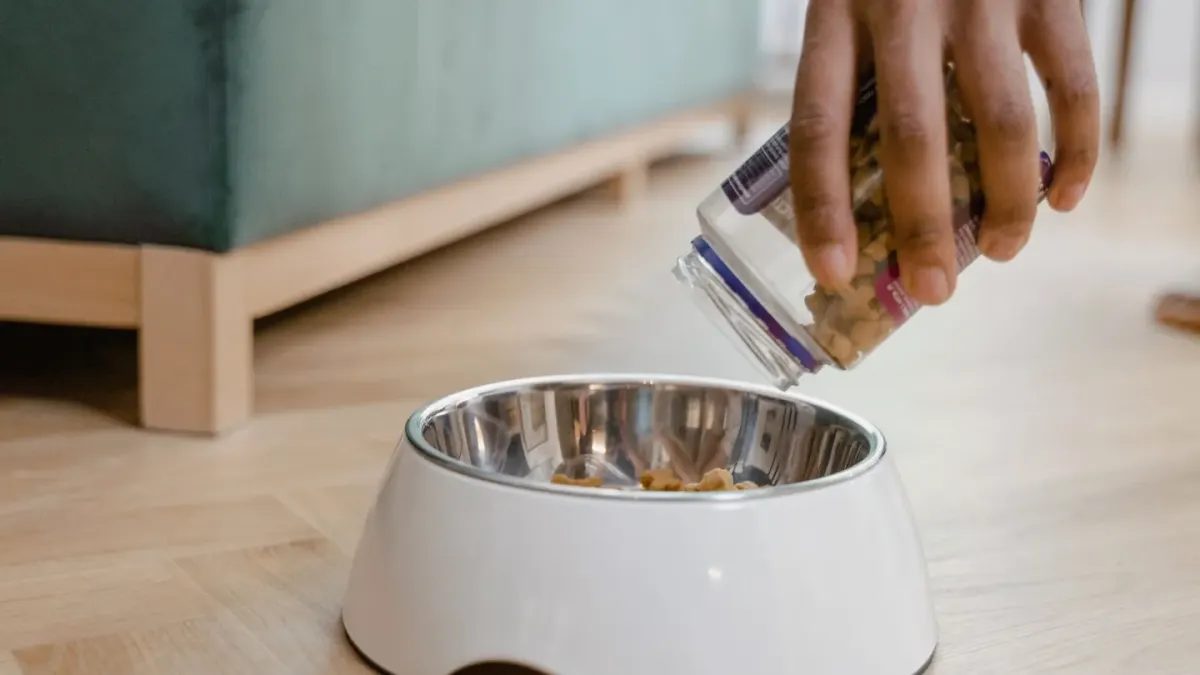
Most fast eaters are just fast eaters — food-motivated, sometimes from a multi-dog household where competition trained the habit early, sometimes because they were a shelter dog who genuinely didn’t always know when the next meal was coming. That’s behavioral, and it responds to behavioral fixes: slow-feeder bowls, puzzle feeders, splitting one meal into two or three smaller ones, or simply feeding dogs separately if competition is the trigger. Preventive Vet lays out a reasonable set of these tools, and I’ll say plainly that they work for the majority of gulpers I see — the goal isn’t to make mealtime a chore, just to stretch it past the point where a dog is swallowing whole air with every bite.
A smaller subset of fast eaters have something underneath the habit. A dog with exocrine pancreatic insufficiency (EPI) — where the pancreas isn’t producing enough digestive enzymes — can eat ravenously and still lose weight, because the food isn’t being broken down and absorbed properly no matter how fast or slow it goes down. That’s treated with pancreatic enzyme replacement, nutritional management using low-residue diets with moderate fat content, and cobalamin supplementation, according to a review in the Journal of the American Veterinary Medical Association. If a dog is gulping and also losing condition, or producing pale, greasy stool, that’s a workup for your vet, not a bowl swap.
What actually stretches out a meal
I’m going to reach for both the practical fix and the diagnostic lens here, because they’re not in competition. For the majority of dogs — the ones eating fast out of habit or competition, not underlying disease — a slow-feeder bowl with raised ridges is the single most effective, lowest-effort change I recommend, and it’s backed by straightforward mechanics: the dog has to work around the obstacles to get each bite, which caps the pace no matter how motivated they are. Splitting the day’s food into three smaller meals instead of one or two large ones does similar work by lowering the total volume swallowed per sitting. For a multi-dog household, feeding in separate rooms or crates removes the competitive trigger entirely, and in my experience that’s often the piece owners forget.
If digestion itself seems off — loose stool, gas, a coat that isn’t holding its shine — a gentle fiber source can help settle the gut alongside slower eating. Pumpkin fiber is a gentle, natural source of both soluble and insoluble fiber, and a balanced gut microbiome supports overall immune function. Neither of those addresses eating speed directly, but a settled gut and a slower bowl tend to travel together in the dogs I see. Separately, a review of the probiotics literature in dogs, published in Frontiers in Veterinary Science, noted that diversity metrics did not distinguish non-responders from responders — a reminder that even well-studied supplements don’t help every dog the same way, and that’s worth knowing before you assume any single product will fix a digestive symptom.
When I’d actually call it urgent
If your dog eats fast and is a deep-chested breed — Great Dane, Weimaraner, Standard Poodle, German Shepherd, Doberman — and you notice unproductive retching, a visibly distended or tight abdomen, restlessness, or drooling after a meal, that’s an emergency room visit, not a wait-and-see. The American Animal Hospital Association is direct about this: GDV can progress from first signs to life-threatening within hours, and it is treated as a surgical emergency, not something managed at home. I’d rather a client come in and it be nothing than the reverse.
Where this actually lands
I’ll say what I’d tell a client sitting across from me. Reach for both the bowl fix and the risk assessment — don’t treat gulping as purely cosmetic, and don’t treat it as purely catastrophic either. For most dogs, a slow feeder and split meals solve the actual problem, which is a dog eating faster than their gut or their airway can comfortably keep up with. For a deep-chested dog, I still want that same fix in place, but I’m watching the conformation risk sitting underneath it, because the research genuinely can’t rule speed out as one contributor among several. If your dog is also losing weight, producing abnormal stool, or showing any sign of distress after eating, that’s not a bowl question anymore — that’s an exam.
A gulping dog usually just needs a slower bowl. A deep-chested gulping dog needs that same bowl and an honest conversation with your vet about what else is on the risk sheet. If you’re managing an aging dog’s diet transitions alongside eating speed, our guide on switching a senior dog to a new food walks through that process step by step, and if table scraps are part of the gulping problem, it’s worth knowing which human foods to avoid entirely — onions among them, covered in why vets say no to onions, every time.
Frequently asked questions
Is it dangerous for a dog to eat too fast?
For most dogs it's mostly a digestive nuisance — gas, occasional regurgitation. In deep-chested breeds it's one factor worth watching alongside others, though research on eating speed as a direct cause of bloat is genuinely mixed.
Do slow feeder bowls actually work?
Yes, for the habit-driven gulper — they physically cap how much food a dog can access per bite, which stretches out mealtime without any medication or diet change.
When should gulping prompt a vet visit instead of a bowl change?
If it's paired with weight loss, abnormal stool, or any retching, drooling, or abdominal distension after eating — those need an exam, not a product swap.
Sources
- Are Dogs That Eat Quickly More Likely to Develop a Gastric Dilatation (+/- Volvulus) Than Dogs That Eat Slowly? — Veterinary Evidence
- How to Safely Slow Down Your Dog's Eating — Preventive Vet
- Exocrine pancreatic insufficiency review — Journal of the American Veterinary Medical Association
- Probiotics and gut microbiome response in dogs — Frontiers in Veterinary Science
- Understanding Canine Bloat (GDV): A Medical Emergency — American Animal Hospital Association