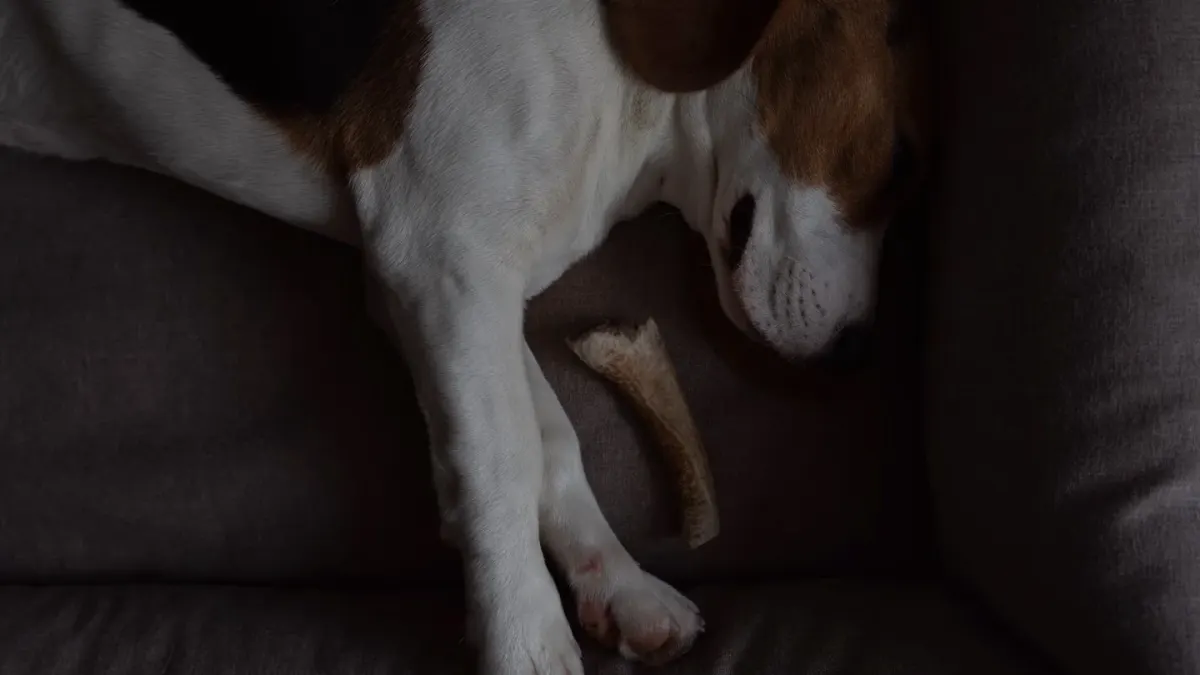
Here’s the fork most owners hit at the pet store: the shelf has a hard nylon bone on one side and a rawhide roll on the other, and the rawhide looks more natural, cheaper, and more satisfying to a dog’s jaw. So which one actually belongs in the house?
I’ve had this conversation more times than I can count with owners standing in my exam room holding a half-chewed rawhide strip, worried they’d made the wrong call. One was a lab-mix owner whose seven-month-old pup, Remy, about 45 pounds, had swallowed a golf-ball-sized wad of softened rawhide during a Sunday afternoon nap on the kitchen tile. The owner hadn’t been in the room for maybe ten minutes. Remy started retching within the hour, and by evening he was at the emergency clinic getting worked up for a possible obstruction. It resolved without surgery in his case, but the scare stuck with the family, and it’s the story I come back to when someone asks me if rawhide is “basically fine.”
What rawhide actually is, mechanically
Rawhide is the inner layer of cattle or horse hide, cleaned, split, and dried into sheets that are then rolled, pressed, or knotted into shapes. It isn’t cooked or rendered the way a bully stick is; it’s essentially raw connective tissue and skin, preserved chemically or by dehydration. That matters for how it behaves in a dog’s mouth. As a dog gnaws, saliva and mechanical pressure soften the surface layer into a pliable, stringy mass — that’s the texture that makes rawhide satisfying to chew, and it’s also the texture that turns dangerous. A piece that started as a rigid roll can, within twenty or thirty minutes of steady chewing, become a soft wad that a dog can gulp down almost like jerky.
That gulping step is where the two real risks live. First is choking: a large, softened piece can lodge in the esophagus on the way down, which is a genuine emergency because it blocks the airway indirectly by pressing on the trachea, and it needs immediate veterinary attention. Second, and more common in my experience, is gastrointestinal obstruction — a swallowed chunk that’s too large to pass sits in the stomach or intestine, doesn’t break down quickly because rawhide resists digestive enzymes, and can require endoscopic or surgical removal. The American Kennel Club notes that dogs swallowing large rawhide pieces without adequately chewing them can end up with the material stuck in the esophagus or elsewhere in the digestive tract, sometimes with serious consequences.
Weighing the trade-off like a nutritionist, not a marketer
I think about rawhide the way I think about any chew: what is it actually giving the dog, and what does that benefit cost against the realistic risk. The upside is real — sustained chewing satisfies a behavioral need, can help mechanically reduce plaque on the tooth surface while the dog is actively working it, and keeps a bored dog occupied longer than most alternatives. But rawhide doesn’t hold its shape the way a dense chew like a nylon or rubber toy does, and that instability is exactly what removes the safety margin as the session goes on. A chew that starts safe at minute one can be a choking hazard by minute twenty, and the dog isn’t going to tell you when that transition happens.
Preventive Vet recommends supervising rawhide closely and taking it away once it’s been chewed down to a size small enough to swallow whole — a threshold that, in my experience, most owners underestimate because they’re watching the clock, not the shrinking piece in the dog’s mouth. I’d add: know your dog’s chewing style before you hand over rawhide at all. A dog that methodically gnaws a chew into shavings behaves very differently from a dog that works a piece loose and then swallows it in one motion. The second dog is the one I worry about, and for that dog, rawhide often isn’t worth the trade even with supervision.
Puppies deserve their own note here, mostly because their chewing needs are so intense during teething that owners reach for whatever’s on hand. If you’re navigating that stage, it’s worth reading about teething toys that soothe a puppy’s sore gums and knowing roughly when puppies stop teething and need different toys, because a young mouth swallows more impulsively and a softened rawhide chunk is an easy target. Toy and small-breed dogs carry their own version of this risk simply because their airway and GI tract have far less room for error; if that’s your dog, it’s worth pairing this with a broader look at exercise ideas for toy and small breeds so chewing isn’t the only outlet you’re relying on.
I still remember a second case that shaped how I counsel families now — an eleven-year-old beagle named Daisy, overweight and an aggressive chewer her whole life, whose owner gave her a rawhide chip as an evening ritual for years without incident, right up until a piece lodged partway down her esophagus on a Tuesday night. She recovered after an endoscopic retrieval, but her owner switched permanently to a slow feeder and food puzzle instead. What struck me wasn’t that rawhide had “failed” — it was that a chew that had been fine for a decade wasn’t a guarantee of safety on day 3,651. Rawhide risk doesn’t average out to zero just because most sessions end uneventfully.
Salmonella contamination is the other piece of the risk profile that’s easy to overlook because it’s not visible in the moment. Rawhide sheets are treated and dried during processing, and if that process is poorly controlled, bacterial contamination can affect both the dog and the humans handling the chew. Buying from manufacturers with visible quality controls, and washing your hands after handling any hide chew, is a small habit that closes off a risk category most owners never think about.
Where I land
Rawhide isn’t automatically dangerous and it isn’t automatically fine — it’s conditional, and the condition is supervision plus knowing your specific dog’s chewing pattern. I don’t hand it out as a default recommendation the way I might a size-appropriate rubber chew, because the failure mode with rawhide is abrupt and can escalate to surgery, not just an upset stomach. For a methodical chewer in a household that supervises consistently and removes the chew once it’s soft, it can be a reasonable option. For an aggressive gulper, a puppy still learning bite inhibition, or any dog left alone with it, I’d skip it and choose something that doesn’t change shape as it’s used. If you’re weighing chew options more broadly by durability rather than material, it’s worth thinking about jaw strength the same way you’d think about size differences in a breed comparison like standard vs. miniature dachshund — the right chew depends on the individual dog in front of you, not a blanket rule.
Frequently asked questions
Is rawhide ever completely safe for dogs?
No chew is risk-free, but supervised rawhide with a dog that chews methodically rather than swallowing large pieces carries a lower risk than leaving a dog unattended with it.
What size rawhide piece is dangerous?
Once a piece has softened enough to be swallowed in one gulp — often smaller than it looks — it should be taken away, according to guidance from Preventive Vet.
Are there dogs that should avoid rawhide altogether?
Puppies still teething, small or toy breeds, and known aggressive chewers or gulpers are the dogs I'd steer away from rawhide most consistently.
Sources
- Are Rawhide Chews Dangerous for Dogs? — American Kennel Club
- Safer Rawhide Chews for Dogs — Preventive Vet